
Creativity or Mindlessness

What is the opposite of creativity? Thesaurus.com notes that it is uncreative, ungifted, unimaginative, uninspired, unproductive or untalented.

Even though in itself each of those individually can be debated to no end, I feel that it is more interesting that this website uses negative adjectives only, to describe the opposite of creativity. Now that may be a lazy website giving a lazy or “uncreative” answer, but it is a common thought that being not creative is associated with the negative.

From young I would treat studying like a machine, and punch words into my head one by one like a typewriter, stamping it into the memory paper of my brain. But in art class and design+tech, it would be about inspiration and my brain wouldn’t really need to repeat and remember things at all.

So when I look back at it what I enjoyed most was definitely these classes. It requires less monotonous work but I was still rewarded with an outcome, a mark or a result just the same as a boring essay would have.

So the opposite of creativity is mindlessness and apathy? Which one is.. better?

If everyone were creative or delved into creative thoughts exclusively, would society sustain? If one were only creative and never did a mindless and repetitive thing in their life, be productive or progressive? No. But neither would it work if you were entirely mindless. This world has both types of people and both are needed for progression and work.

However as I mentioned, too many times repetitive work is seen as lack of creativity and negative. This is what I would like to challenge, or would try shift the social norm if I could. It may not be good to be a robot for your whole life, but never look down on people that are or choose to be mindless in work or in life. I say this not because I worry for creative people’s egos, but because you will lose sight of the value of hard work and forget to appreciate the other side of the coin. I see a problematic trend towards creativity, especially in the younger, generation Z (due to multiple factors such as spoiling but this is another time), that idolises creativity which is very dangerous. Hard work will always and forever be a stronger foundation.

(one moment)

Continuing on to my childhood school memories (I feel so old), there were classes at the same time that involved plenty of work and repetition (mathematics, piano) but these subjects hit a point that was different, where it felt natural, almost creative. These subjects were the ones I were good at and enjoyed but required immense amounts of work. This is where I felt contradiction, that tasks or subjects that involved such prominent hard work and repetition in the form of past papers and textbooks of exercises, were in turn becoming natural and organic. It was as if the answers came to me and I wrote them down, instead of going through my mind to find those answers.

To make the connection to creativity is that, creative work is often liken to be, creating or recording what your imagination brings to you. That is, it is not from reciting or remembering that brings out the creation.

To pair with this thought, I recently found this chart –
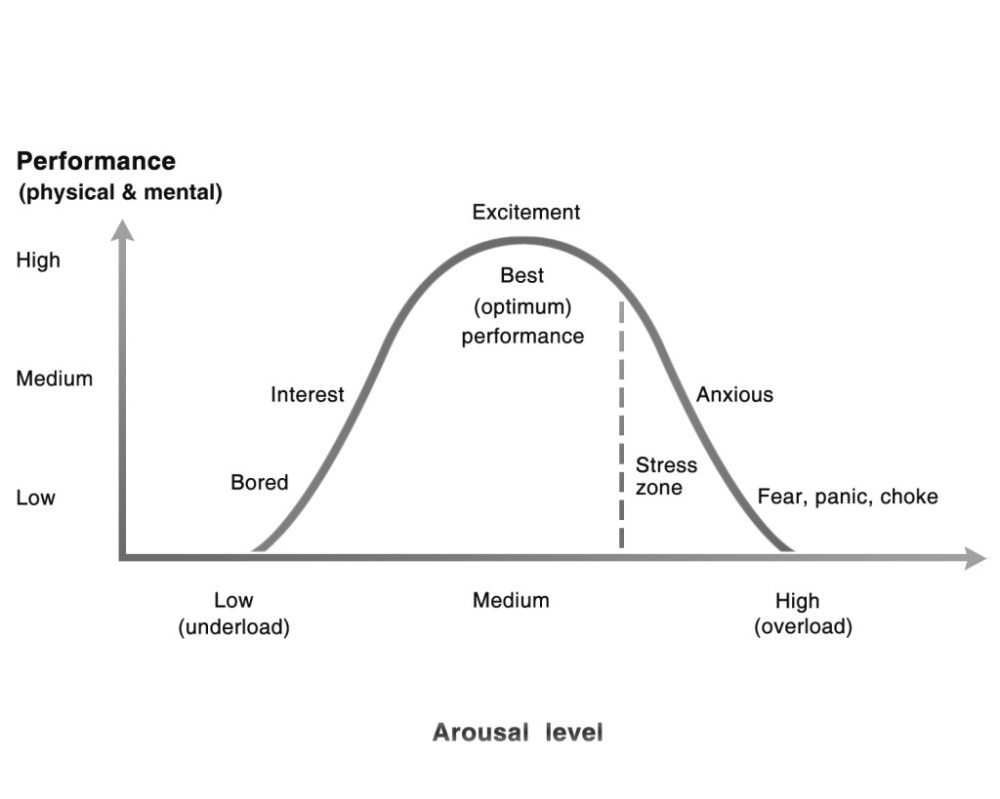
arousal-chart
Yerkes-Dodson Law (sort-of, modern version at least)

I feel that this graph really sums up where I want to get at in this long winded post. Maybe my question into what is the opposite of creativity lead me to question the definition of creativity.

Creativity, as I have talked about here, I am considering more as passion, interest and ‘arousal’. I wanted a clear explanation as to why creativity is preferred and why I felt so strongly that it is also a caveat and weakness if not managed well. The Yerkes-Dodson Law is a psychological perspective of the relationship between performance and arousal. Too little arousal is apathetic, too much arousal is stressful and leads to anxiety. There is a peak performance which lies in the optimal middle of the graph, of ‘arousal’.

To summarise, Creativity is preferred because it is a form of arousal, of natural discovery which involves imagination and feelings of ecstasy and primal joy. Whereas repetition is boredom which leads to deeper emotions of disgust (Plutchik’s wheel). But as boredom leads to disgust, creativity if overloaded will lead to anxiety and stress. That is why, as always with everything in this damn world(!), it is always important to practice moderation and reap the benefits of each type of action or form of emotion.

Never let creativity slip away and for you to fall to boredom, but don’t dream so much that you live in a world of imagination that leads to no progression or work. There is no secret to success but these two opposites. And never let this sort of contradiction sway the direction which you are walking, instead question the reason of your path.

Conflict of the Heart and Mind

Your heart does not listen to your mind. It feels like it even has a mind of its own..

You can give the best advice in the world and yet not follow it yourself because what you believe is right, is not necessarily what you want to feel.

Your mind deduces and calculates what is right and what is wrong. Whereas your heart feels what is right and what is wrong. 

Which is more correct? If I give advice I don’t follow, does it mean I should not give that advice or does it mean what I want to do is not right?

I believe a lot of people have this conflict and it causes internal confusion. If you’re looking for an answer, in my opinion I would say that both is right. 

The heart is the instinctful childish side of your thoughts where the mind embodies the learned, sensible and structured thoughts. Neither is more correct but you have to live with both. 

Too often I have seen people that ‘believe’ in one side and only rely on one side for all the decisions in life. I can go into examples but if you take a moment to consider both mind and heart you may realise sometimes in different situations different side is better. 

In life you can only make a wrong choice if you take advantage of people so as long as your thoughts are not about that, let yourself wild and try to listen to both sides for once and take chances. Close your eyes and follow your heart, think it out and make logic trace out your path. Do both. 

Don’t be a grumpy Joe of structure and stiff logic but don’t be the ditsy Daisy of thoughtless endeavours. 

Life is about balance and balance is what brings true and lasting love and happiness. 

Elevator (or lifts) – a Symbol of System

I stood on ground floor staring at the level indicator of the elevators at my office. It was stuck there at level 5 for a whole damn minute. I swore I’d kill whoever came out at ground floor for holding up the lift.

Ding. The lift arrives on ground floor and my angry face is ready. Door opens and there is no one. I get over it quickly and head into the lift to work.

As I thought about it on my trip up, lifts and elevators are a great symbol of a system. One where human input, interactions and sense of responsibility is very important. As someone held the lift open on level 5 (for what reason I actually don’t understand as no one actually entered it), it symbolises those that selfishly hold back the system in order for self gain.

By holding up the lift, the other lift that is higher up, will not come down. Instead it will wait there, on a higher level, assuming the lower lift will move. This ‘assumption’ is coded into the system.

A system is only as great as the users allow it and if the governing laws and ‘assumptions’ are not followed by those that use it, it will not function efficiently. When the people start becoming more selfish and less community-focused then certain actions will cause trouble but even more importantly, cause stutters and unnecessary pauses in the system.

Give you another example – cars merging lanes in order to find a clearer lane, in traffic. If everyone stays in their damn lane, and moves at an average pace, every person will reach their destination at the fastest speeds. But no, everyone just wants to keep pushing in and maximise their gain. Slow, stupid, inefficient, so damn frustrating.

But can we blame people? When traffic is caused by bad road design and when people take the lift up as every lift coming down has been full, these bad behaviors causing inefficiencies are a response to bad system design. In a perfect world the system would be perfect so the users would not need to think of ways to take advantage or find shortcuts.

I guess you could apply this to governments and the people as well but eh that’s too heavy. This is just my thoughts after waiting for a lift as I was late for work. But at least now I have promised myself never to hold up a lift. If it goes it goes, I will wait for the next one. At least I won’t be the reason for the system to fail.

RHYTHM AND ROUTINE

The first post in my ‘ponderings’ category, let’s see how long I keep this up..

Recently both these words have been on my mind. Rhythm and Routine. As a data lover it is sometimes hard for us to grasp things that can not be explained with number. One day I was bumping to music in the shower in the morning, getting myself into a good mood for a good day’s work, I thought about this – How is music so personal and immediate, so much that just listening to it can bring out people’s emotions. Is there a formula for the perfectly catchy song? Is there a secret recipe for an enjoyable song? If I am able to decode it, can I mass produce this?

There’s the obvious mass-market mainstream hit and then there’s the niche songs for certain moments or moods. Let’s focus on mainstream here as I want to apply this to a business perspective. Hear me out.

At this point I associated a good business idea or product should be like a song, the moment people hear it or experience it, they are hooked. The continuation and perpetuity of your product will depend on how many times someone can replay it without getting bored or wanting a different song or product. So far it makes sense.

But what specific part of a song makes it so emotionally stimulating, is it the lyrics, the notes, the singer’s voice? Or is it rhythm? I’m sure the answer here could be different across different people, with a lot of combination of what’s most important as well but for me I specifically feel, rhythm. A song with good rhythm feels routine and consistent. I like that.

Reflecting on my brief delve into mixing music, you learn to counting bars and beats of 4. Deciphering a song into bars of 4 allows you to start the blend, introduce a new instrument or let the beat drop. It felt good being able to predict what is going to happen next even if never having even heard this song. This is the basics of DJing.

Alright, I am going off topic. But the keyword here is rhythm. If someone can effortlessly adopt your product, it has to have a good rhythm. It has to have something that is found, felt or experienced every day already. It needs to feel natural and it can not be forced. Just like a wrong note or an off beat or a fragmented rhythm, this will ruin the whole experience. That is why I must always remember rhythm, in everything I do, everything I create. Rhythm is not only important for a product innovation however, but in people management, in personal sanity (haha) as well.

Every mass-market product needs to have some sort of element of routine hijacking.

But how do you create rhythm in a product? This may seem difficult at first but my most immediate response to this question is – routine. If you can build into the routine of people’s lives, you can create something that they can adopt. Although changing consumer behavior is very difficult (a discussion for another time), in the least I now believe every mass-market product needs to have some sort of element of routine hijacking. “Routine Hijacking” – Maybe I’ll use this term more as well.

Just take Uber and Deliveroo for example. Every day like an after work ritual, I will open these two apps. They have so successfully and effortlessly integrated into my life after providing me convenience and being very user friendly. Google? Google hijacked all our routines.

I guess in conclusion: A song’s success is very similar to the success of a business idea. The more easily people can sing along, the easier it will be perpetuated and the higher the chance of success.

(Hm.. note to add some sort of images here later)